Rail Travel Races to New High
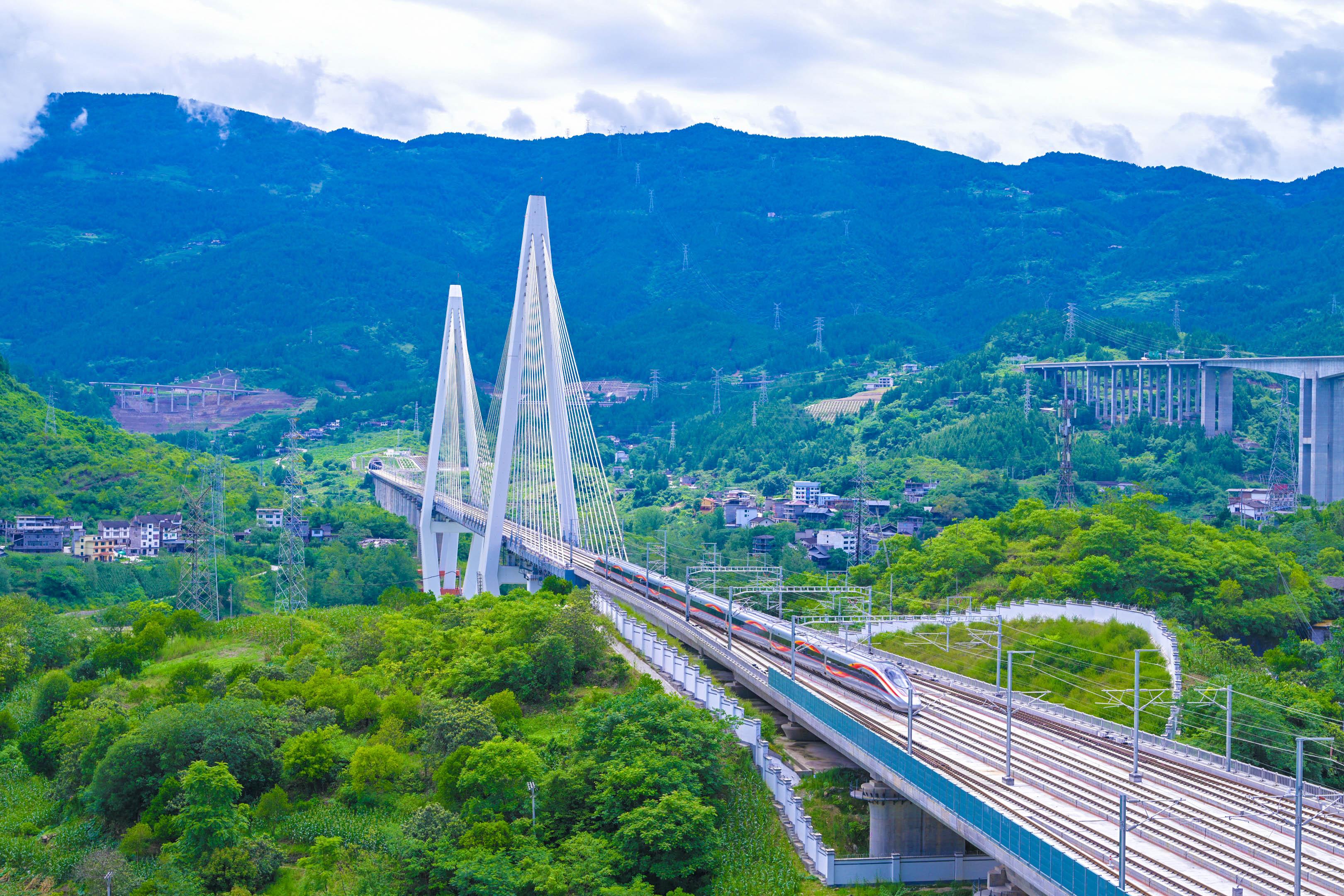
On a breezy July morning in Beijing, international guests stood in awe outside the National Railway Test Center. What caught their attention wasn't just China's engineering prowess — it was the hum of history in motion: the CR450, the world's first high-speed train designed for a commercial speed of 400 km/h, quietly preparing to redefine the future of rail travel.
Inside the facility, the CR450 prototype crouched on the track — a product of years of engineering breakthroughs, system overhauls, and bold experimentation. As part of the 12th World Congress on High-Speed Rail, the train offered a rare glimpse into China's next leap in rail innovation. Behind its streamlined silhouette lies a story of relentless problem-solving and frontier research that has pushed China's railway science into what experts call an "uncharted innovation zone."
Entering the "permanent magnet era"
To increase operational speed by 50 km/h compared to the previous CR400 model, engineers first had to fundamentally rework the train's traction system. The CR450 marks China's entry into what local researchers call the "permanent magnet era"—a shift powered by high-efficiency, domestically developed permanent magnet synchronous motors.
However, integrating this motor type posed risks. "If a short circuit occurs between motor windings, the motor doesn't stop due to the magnetic field," explained Zhao Hongwei, chief researcher at China Railway Academy. "This could threaten operational safety."
To address this, the team developed a groundbreaking three-phase active short-circuit protection mechanism. Within 0.2 seconds, the system detects a fault and redirects current through a closed loop, preventing mechanical damage. After months of lab trials, the on track breakthrough was made during a critical speed test in June 2023.
On the cross-sea Meizhou Bay Bridge, two CR450s were launched on trial runs. The test confirmed that the CR450 can reach a peak single-train speed of 453 km/h, a 1.6x increase in power over standard levels, while maintaining safety and reliability.
Reducing air drag by 22%
At 400 km/h, 95 percent of resistance comes from the air. This presented another hurdle — how to reduce aerodynamic drag while maintaining structural integrity.
Early in the development, engineers believed the shape of the train's head had been optimized to the limit in the CR400 series. But inspired by the beak of falcons and the shape of arrows, the team revisited the head design through biomimicry. The resulting model trimmed drag by 2.6 percent.
Still far from the target of over 20 percent reduction, the team dug deeper. The breakthrough came not from the train's nose but its underside — specifically, the bogie area. "We realized that the undercarriage contributed disproportionately to overall resistance," said Shao Jun, the lead aerodynamicist.
Their ultimate solution was to cover the bogie with a specialized aerodynamic shell. Combined with a streamlined body, low-drag pantographs, and redesigned surface geometry, the final system achieved a 22 percent reduction in drag, keeping energy consumption equivalent to CR400 levels despite the speed increase.
Braking from 400 to 0 in 6.5 km
Speed is meaningless without control. From the start, the developers insisted that the CR450 must be able to brake from 400 km/h to zero in the same distance as the CR400: just 6.5 kilometers.
That meant absorbing vast amounts of energy in mere seconds. "That energy is enough to boil 6.8 tonnes of water in two minutes," said Cai Tian, a brake system researcher. The team had to invent entirely new high-temperature, fatigue-resistant brake materials. Over a hundred prototypes were tested before a final formula emerged.
They also rebalanced the braking force across different rail cars due to reduced ventilation from the aerodynamic shells. Using a multi-stage adhesion control system — akin to easing gently on snowy roads — they gradually applied braking force to avoid wheel slip.
Thousands of tests later, researchers mapped the world's first braking adhesion curve for trains operating at 400 km/h, setting a new benchmark in international rail safety. With over 200,000 kilometers of field trials completed, the CR450 is now entering its final verification phase. More than just a machine, it represents a national determination to stay ahead of the curve — delivering faster, safer and greener travel in a world that demands nothing less.